Hi, this is a comment.
To get started with moderating, editing, and deleting comments, please visit the Comments screen in the dashboard.
Commenter avatars come from Gravatar.
Queer Feminist Approaches to Media, Art & Resistance Reading Group
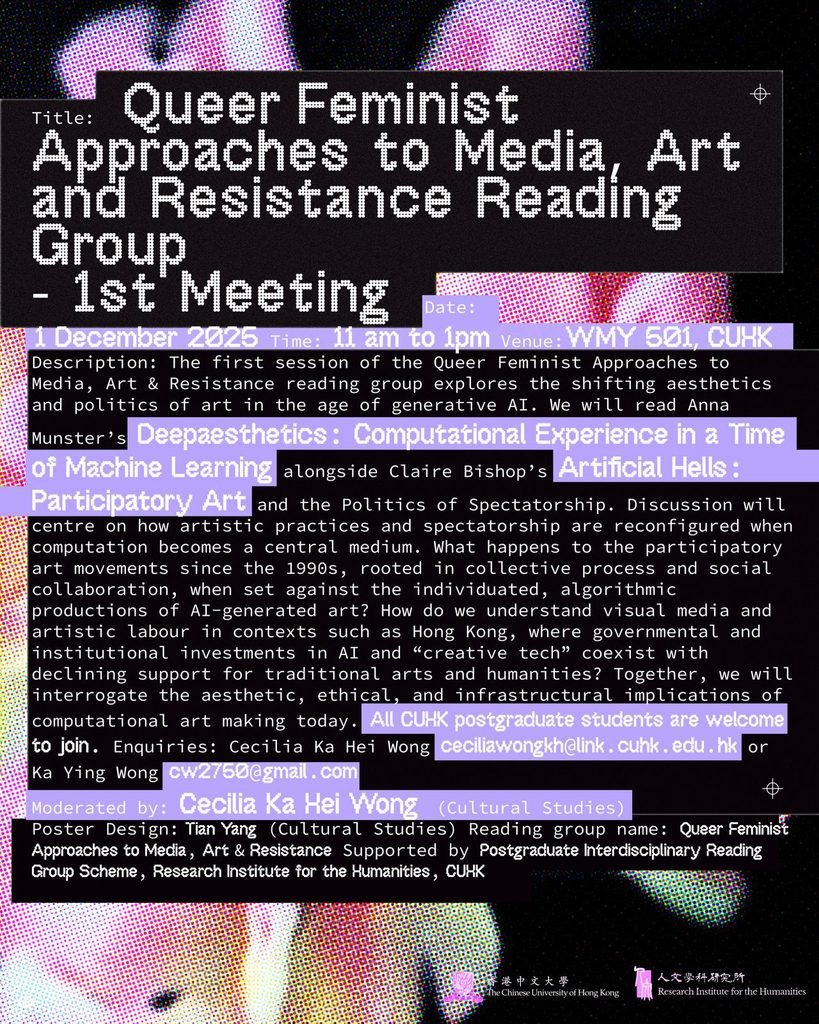
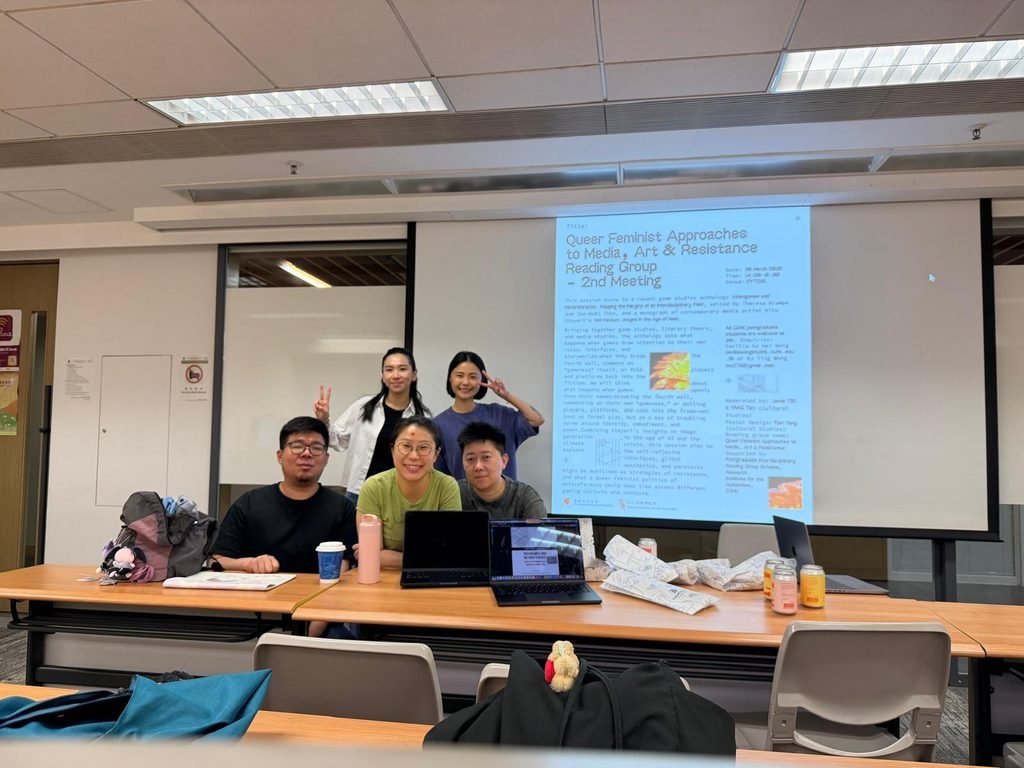
I am one of the organisers of the Queer Feminist Approaches to Media, Art & Resistance Reading Group, an interdisciplinary initiative funded by the Research Institute for the Humanities, Faculty of Arts, CUHK. Together with Ka Ying Wong, Tian Yang, Jamie Wing Tung Tse, Aaron Lam Kwok Yam, and Xu Yijie, we created critical conversations across cultural studies, fine arts, and history.
The reading group brought together postgraduate researchers interested in queer feminism, digital media, science and technology studies, artistic practice, and climate justice. Our goal was simple: to think across disciplines and explore how culture, technology, and power shape the world we live in, while imagining more just and creative futures.
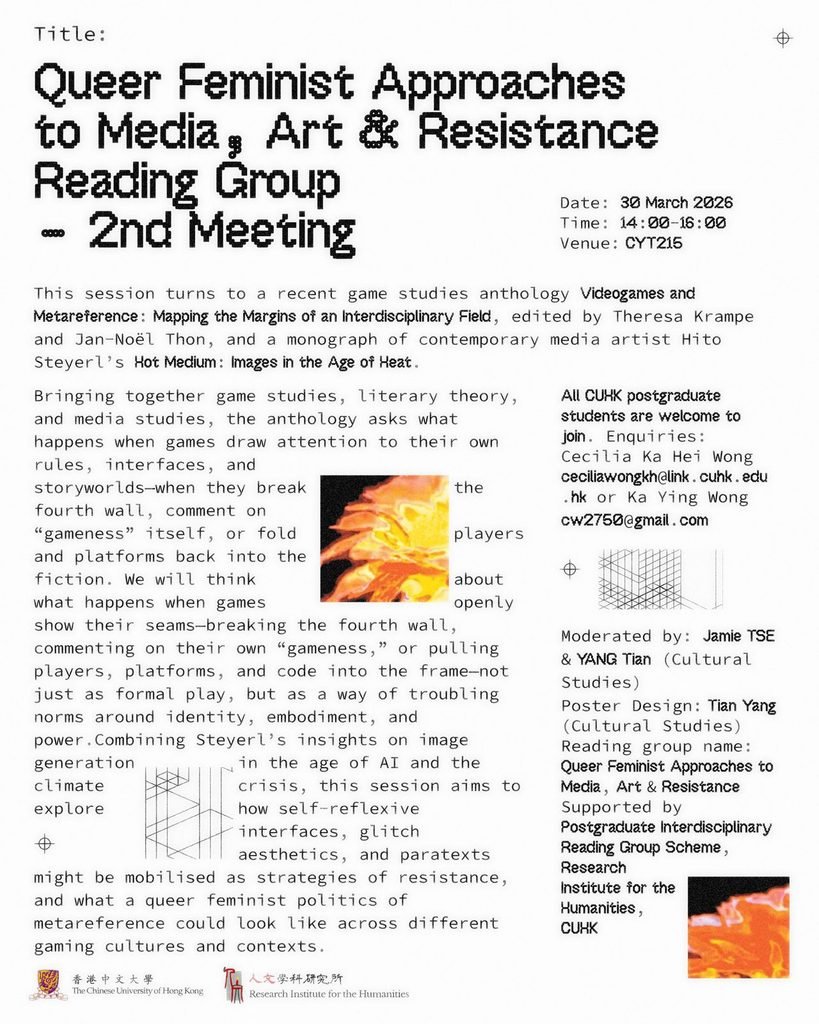
Together, we read and discussed books including:
Videogames and Metareference: Mapping the Margins of an Interdisciplinary Field (Theresa Krampe & Jan-Noël Thon, eds.)
More Than a Glitch: Confronting Race, Gender, and Ability Bias in Tech (Meredith Broussard)
DeepAesthetics: Computational Experience in a Time of Machine Learning (Anna Munster)
Medium Hot: Images in the Age of Heat (Hito Steyerl)
From Reading to Public Dialogue
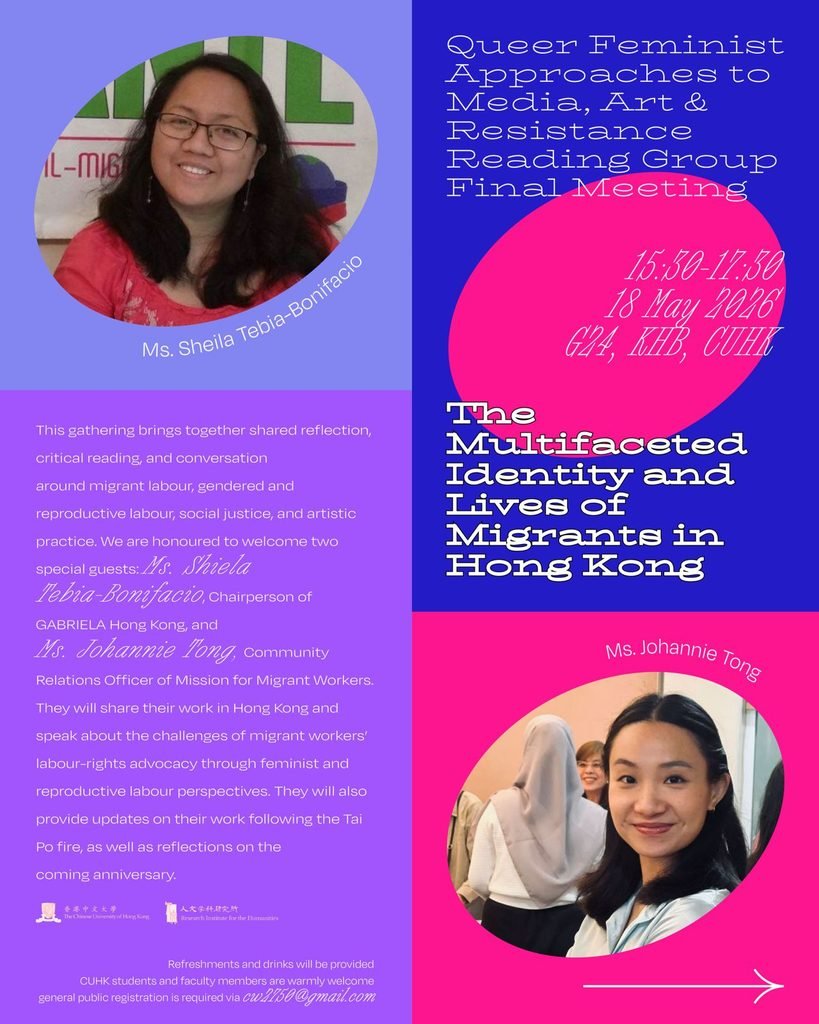
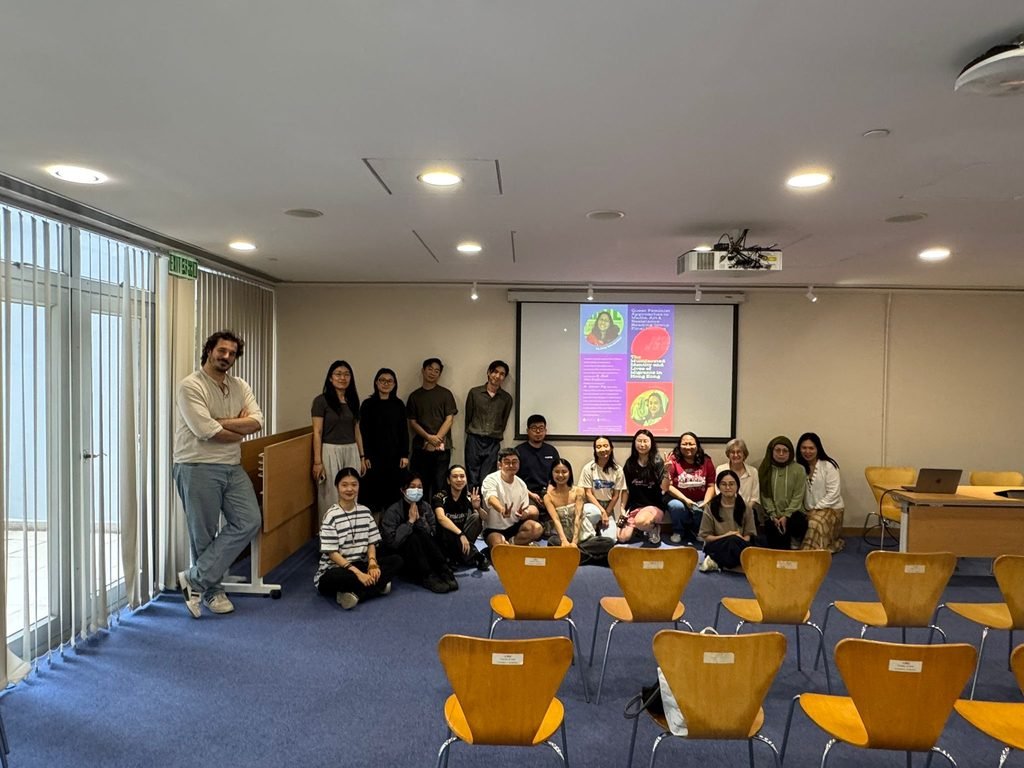
We believe that knwoledge should not stop at academic discussion. We extended our conversations into public engagement through The Multifaceted Identity and Lives of Migrants in Hong Kong, a public event that concluded the reading group.
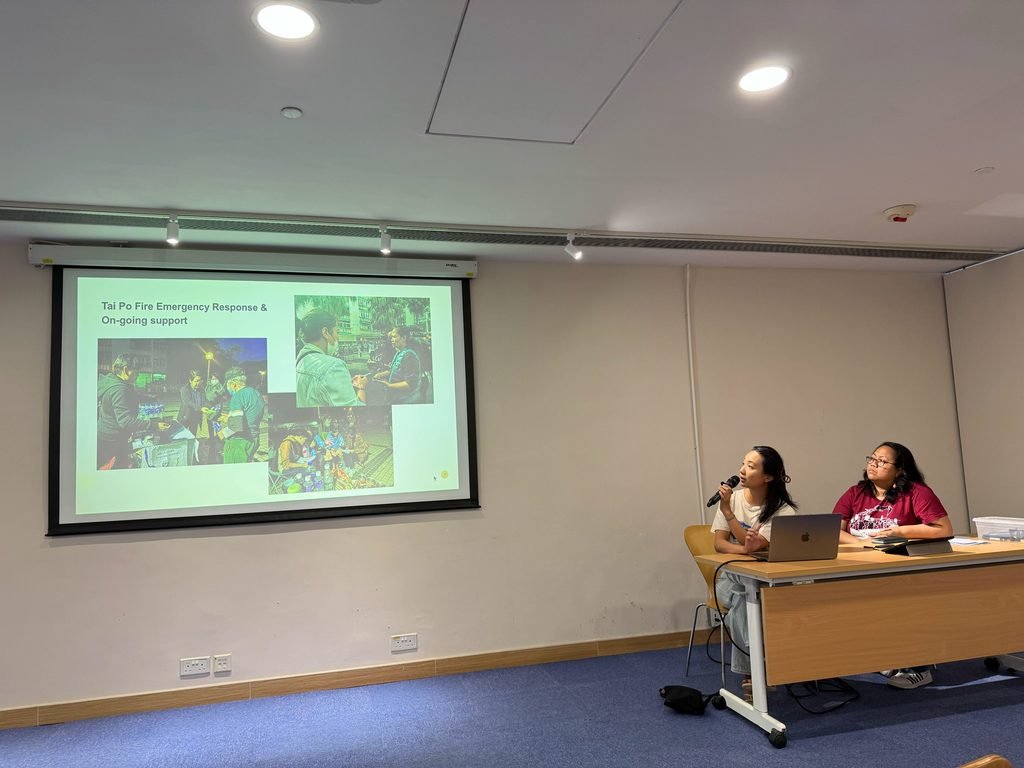
The event brought together Ms. Shiela Tebia-Bonifacio, Chairperson of GABRIELA Hong Kong, and Ms. Johannie Tong, Community Relations Officer of Mission for Migrant Workers (MFMW), to discuss migrant workers’ experiences and labour-rights advocacy in Hong Kong.
By connecting academic discussions with community voices and lived experiences, the event created an opportunity to reflect on migration, labour, gender, and social justice beyond the university.
Why This Project?
Through this reading group, we build friendship, support network for research, artistic practice, and social engagement. The project reflects our broader commitment to building critical conversations across disciplines, communities, and forms of knowledge.
Critical AI Reading Group
I am part of the organising team behind the Critical AI Reading Group, an interdisciplinary initiative exploring the cultural, political, and social dimensions of AI.
The group was initiated by Gabriel Antonio Solis, a Cultural Studies Postdoctoral Fellow at CUHK, after participating in the Digital Feminisms in Asia Symposium I convened and organised. Gabriel invited me and Maari Sugawara (School of Creative Media, City University of Hong Kong) to join him in building a reading group for critical conversations on AI. The group is supported by Prof. Xuenan Cao’s Generative AI Research Project and Prof. Jia Tan’s Digital Feminisms in Asia Project, both Research Institute for the Humanities funded research projects at CUHK.
Our second meeting reading Karen Hao’s Empire of AI.
As a researcher working on digital culture, platform studies, critical AI studies and queer feminism, I see the reading group as an important opportunity for thinking beyond the hype of AI. Rather than treating AI as a purely technical issue, we also look at how AI is shaped by power, labour, culture, and politics.
Together, we invited researchers and students from different disciplines into conversation around some of the most influential works in critical AI studies, including:
Empire of AI by Karen Hao
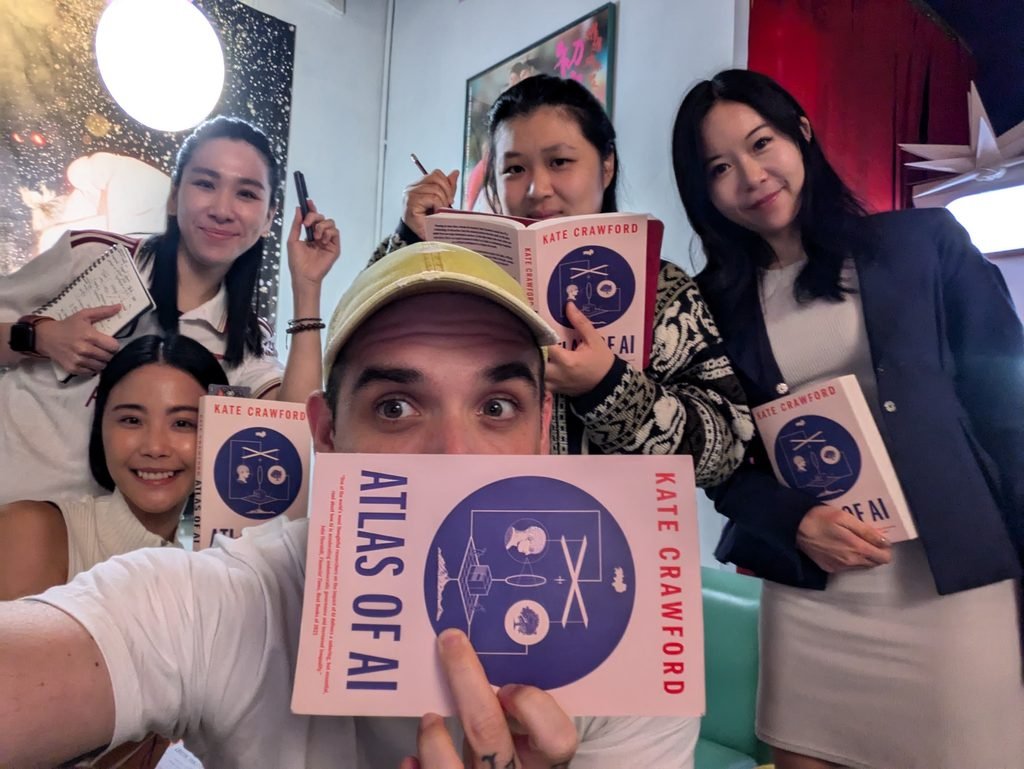
Atlas of AI by Kate Crawford
DeepAesthetics by Anna Munster
Blood in the Machine by Brian Merchant
Bogna Konior’s The Dark Forest Theory of the Internet
Why This Project?
For me, critical AI research is about understanding both the technological logic and the social worlds that technologies produce and reinforce. Through this reading group, my friends and I help build an interdisciplinary community where people can engage critically with AI, challenge dominant narratives, and imagine alternative technological futures.
Feminist Dream Walking 2025 & 2026
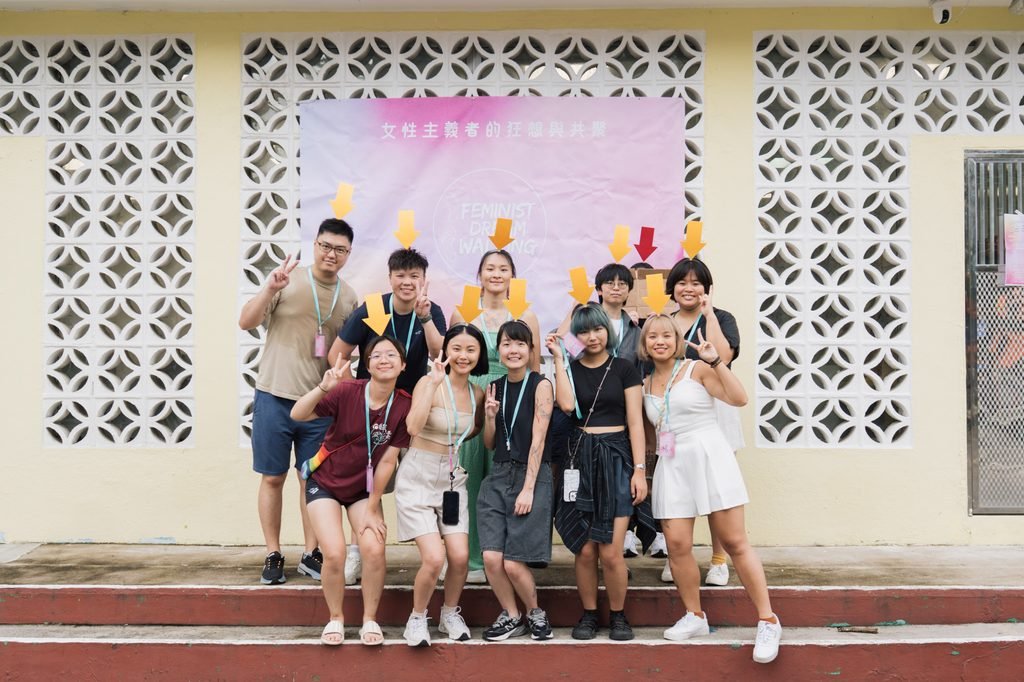
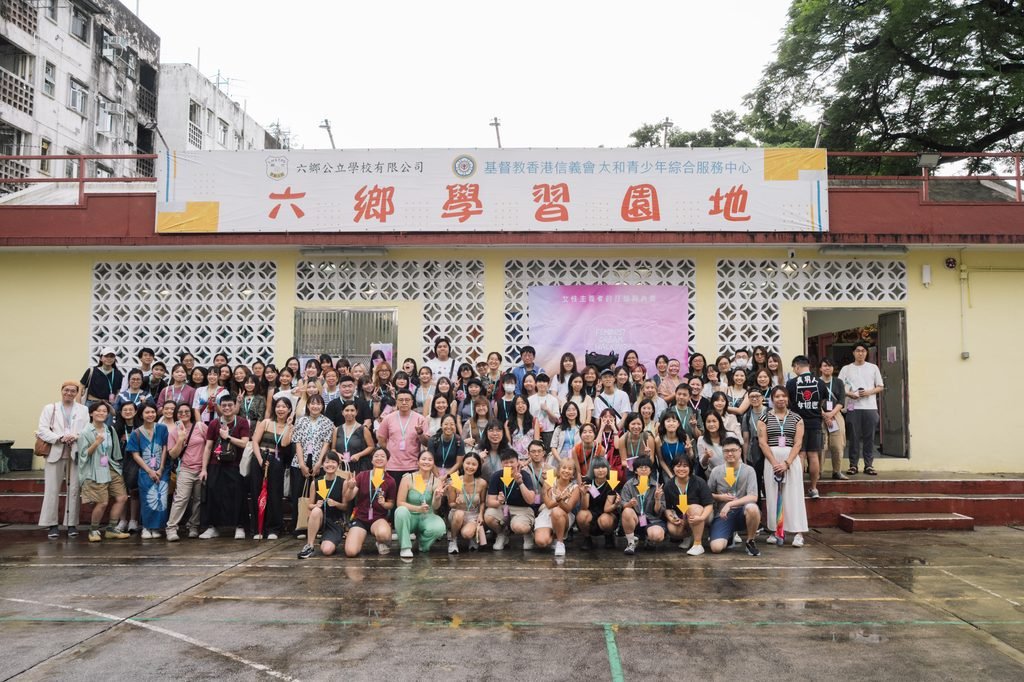
I am part of the organising collective behind Feminist Dream Walking (FDW), a feminist initiative and an annual gender festival in Hong Kong. Invited by feminist organisers and community workers Jacinta Gun and Felicia Sze-to, I joined a team of community organisers to create spaces for feminist exchange.
In 2025, we organised a Feminism101 workshop and a public conference with more than 150 participants. In 2026, we experimented with a more decentralised format, including a feminist drink party, a Feminism101 workshop, and a camp.
As an academic, my contribution focuses on transforming feminist knowledge into accessible and creative public engagement. Rather than relying on lectures alone, I use creative methods to encourage dialogue and collective making.
Feminism 101: Learning Through Creative Practice
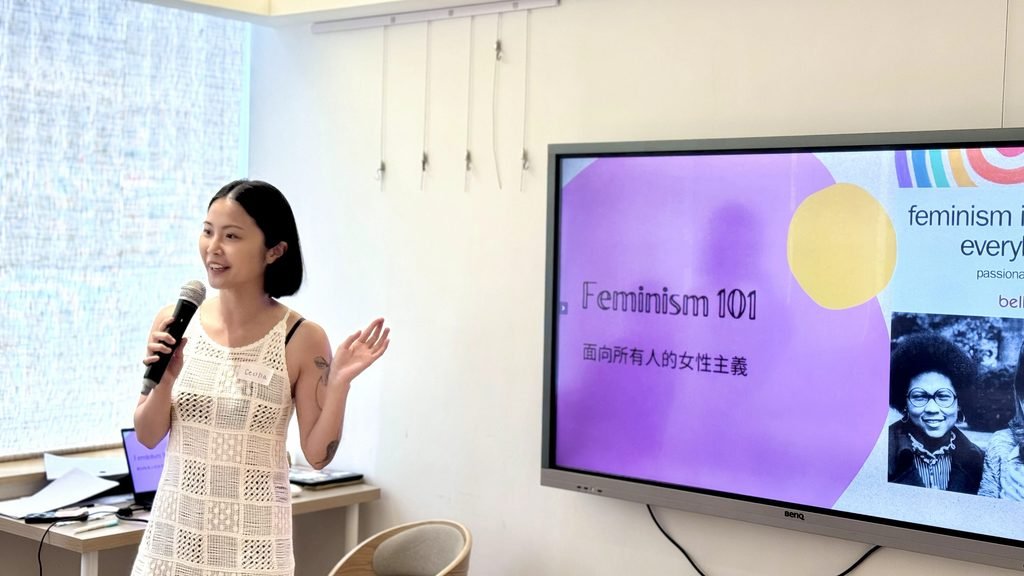
For both editions of FDW, I helped design and facilitate Feminism 101, a workshop for people with different levels of familiarity with feminist ideas.
In 2025, I gave a short introduction to key feminist concepts and co-designed a series of activities that encouraged discussion and reflection. A recap of the workshop can be viewed here.
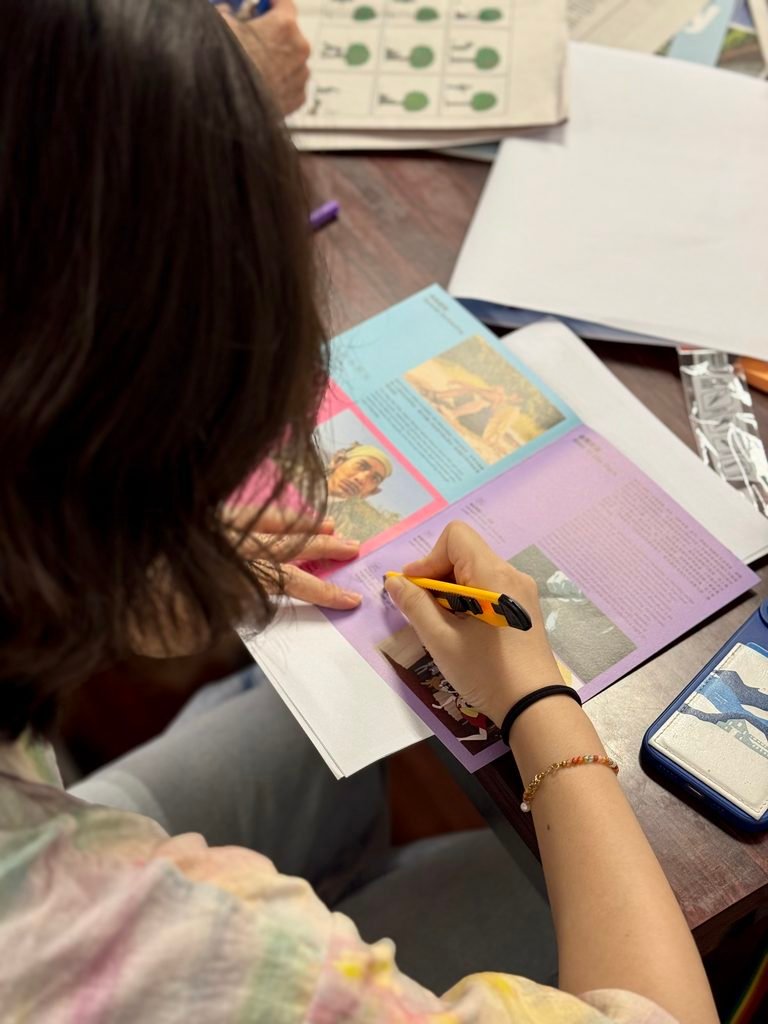
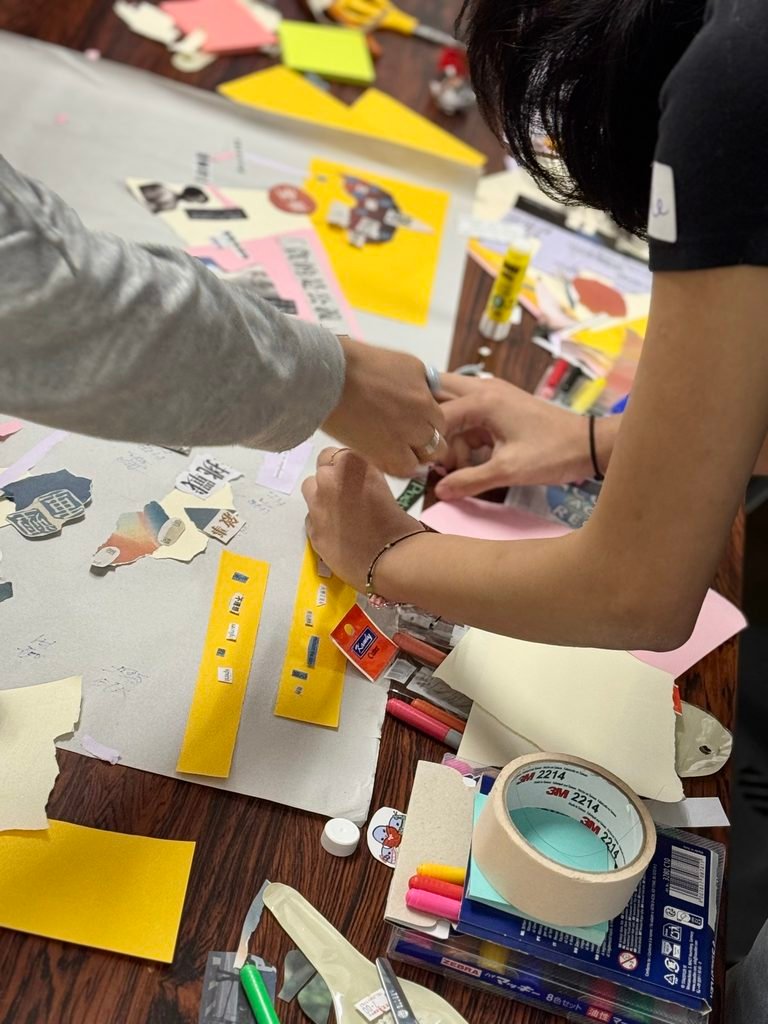
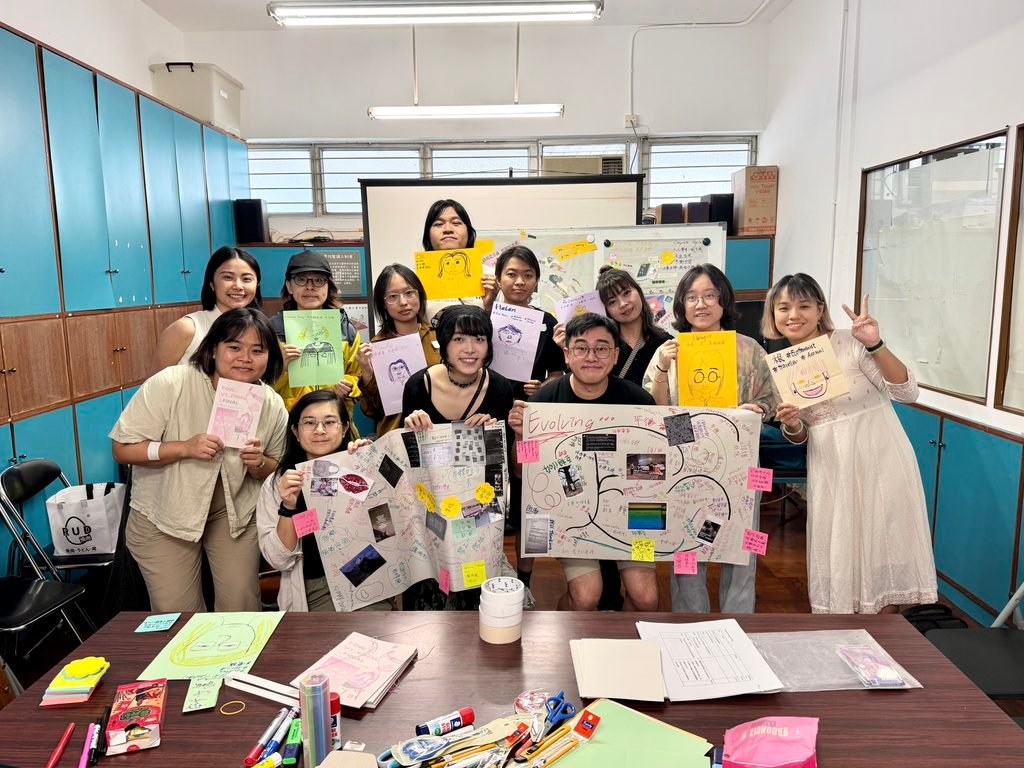
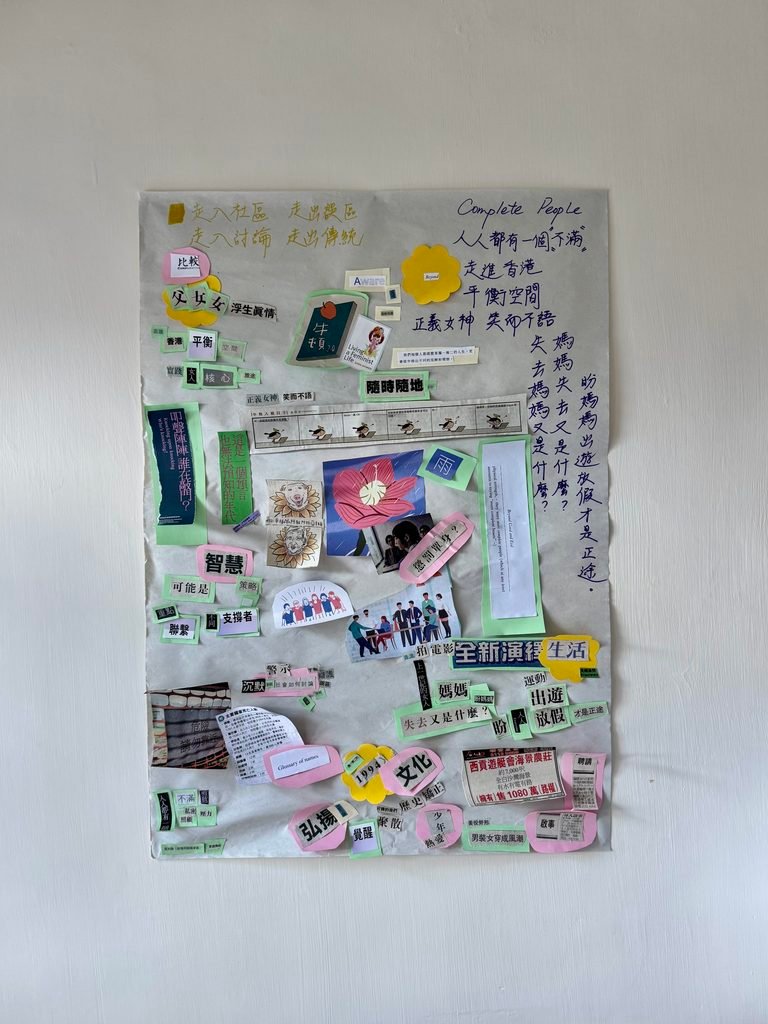
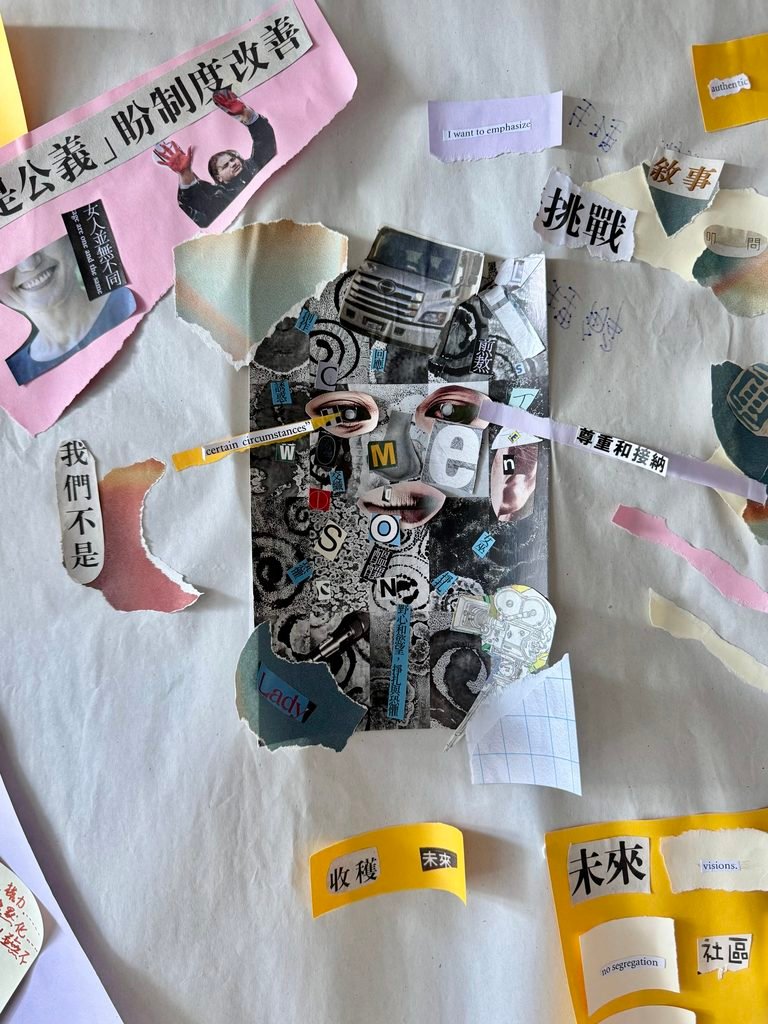
In 2026, my team and I moved towards more creative methods and facilitation. Using collaborative mapping and cut-out poetry, we created opportunities for participants to share experiences and explore different strands of feminism together through making.
These workshops reflect my broader interest in creative approaches to public humanities, where knowledge is not only taught but also produced through everyday conversation and collective practices.
Self-Publishing as Feminist Knowledge Making
One of my main contributions to FDW was initiating two self-publishing projects to document and share the collective’s work. Created without institutional funding, these publications were made through voluntary efforts, shared resources, and a commitment to public knowledge.
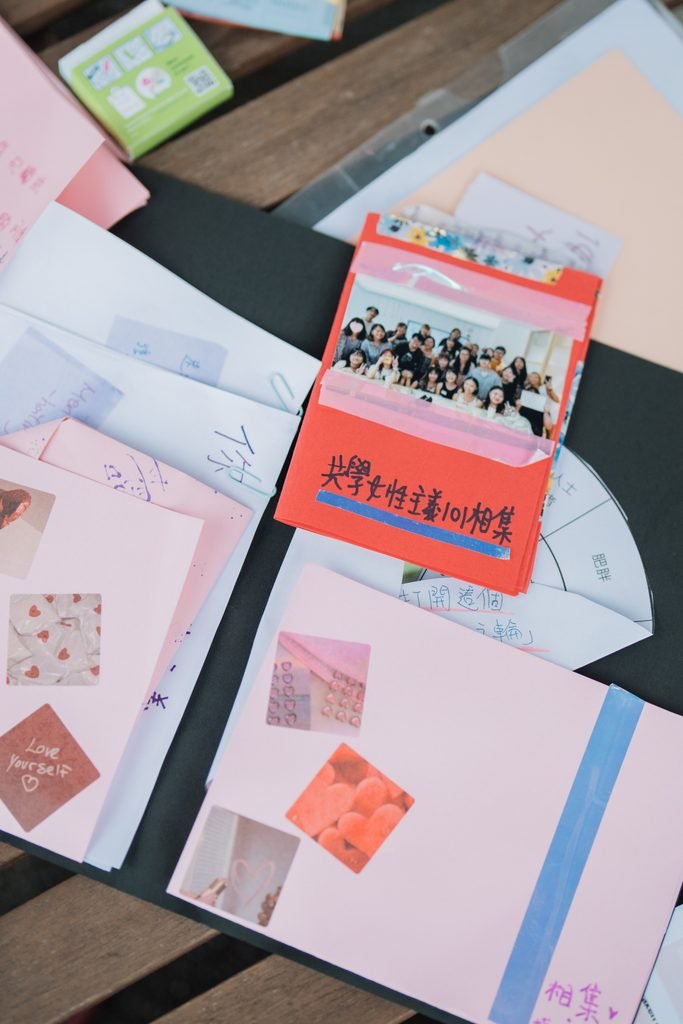
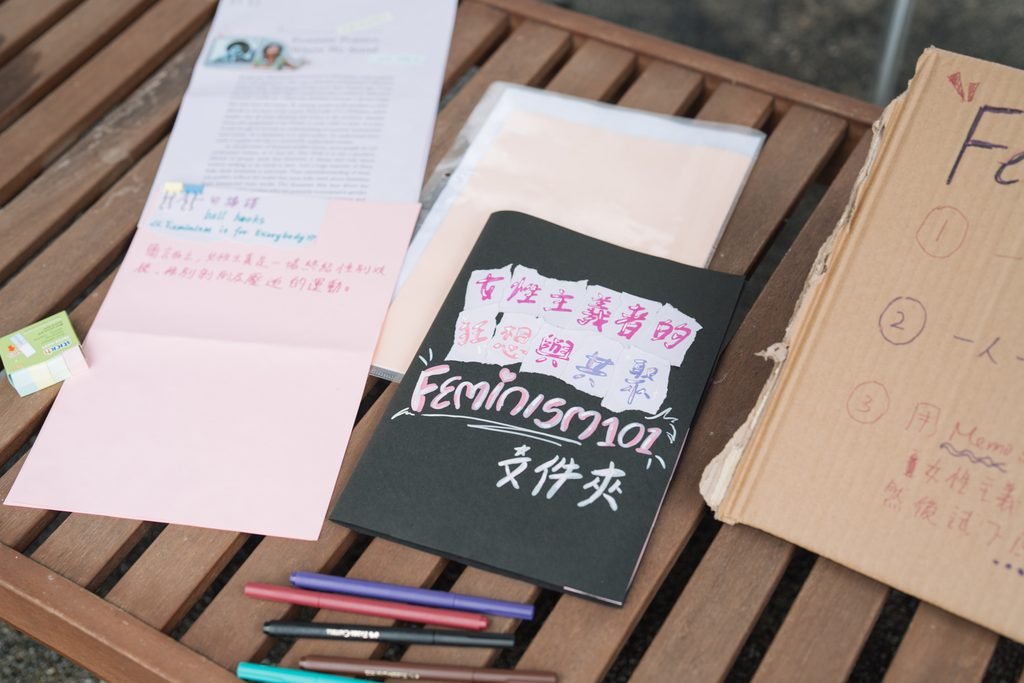
Feminism 101 Folder
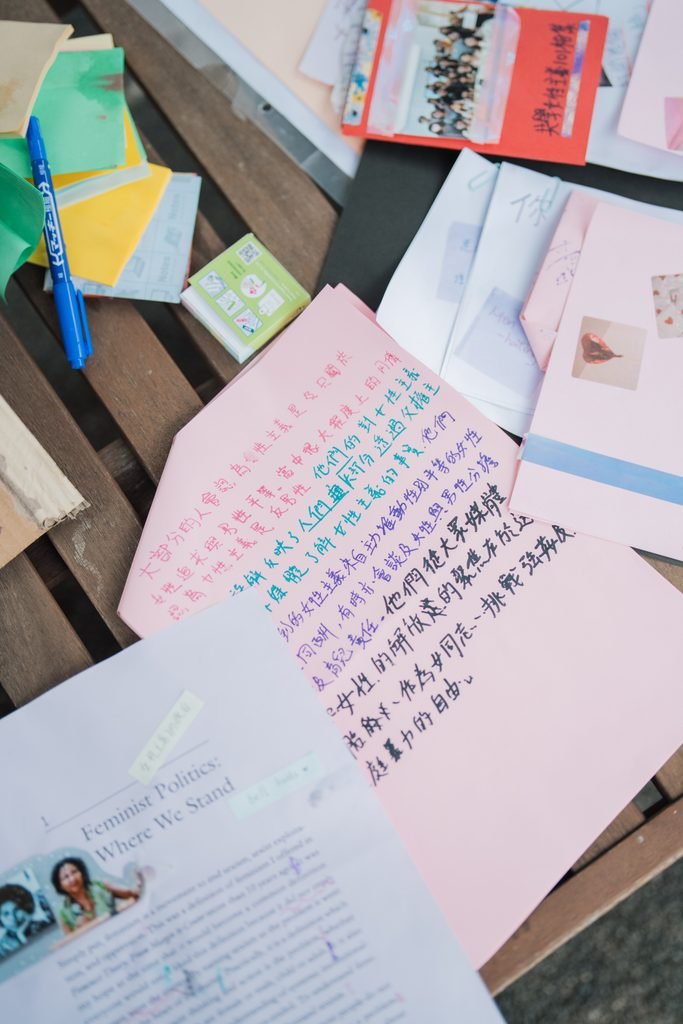
The Feminism 101 Folder documents our workshop in 2025 through photographs, workshop materials, and collaborative translations of excerpts from Feminism Is for Everybody by bell hooks. Flip through the Folder here.
Instead of producing a polished publication, we chose a simple folder format. The design reflects the unfinished, collective, and low-budget nature of grassroots feminist organising. We assembled it together after the workshop as a way to reflect on the experience and continue the conversation.
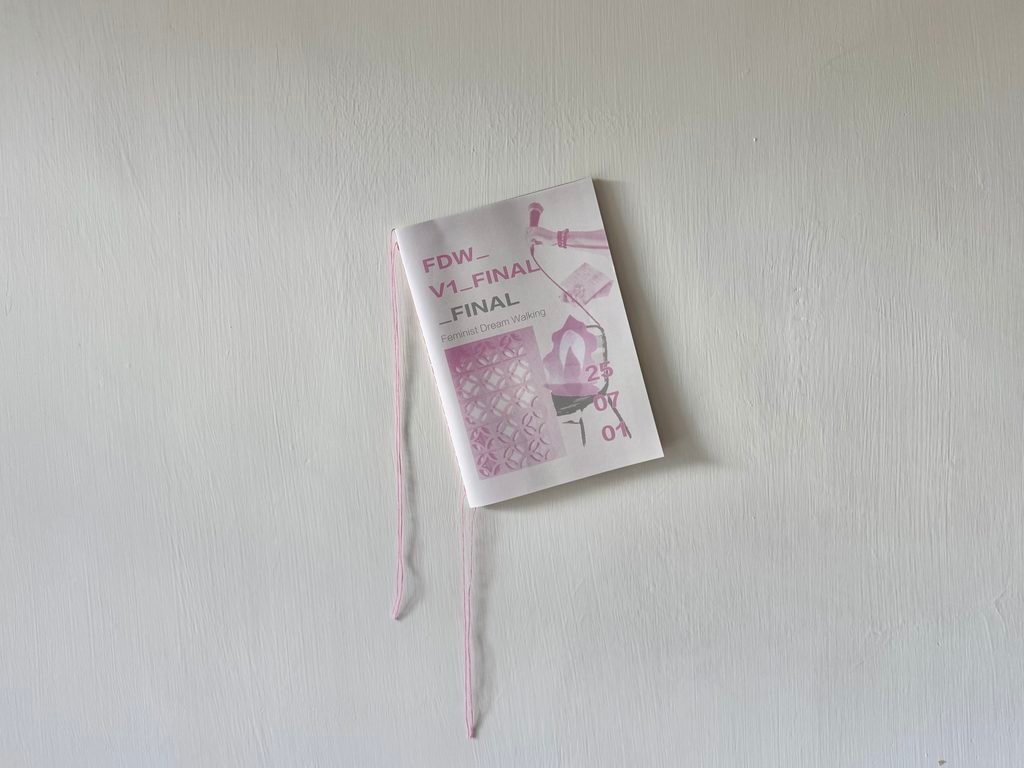
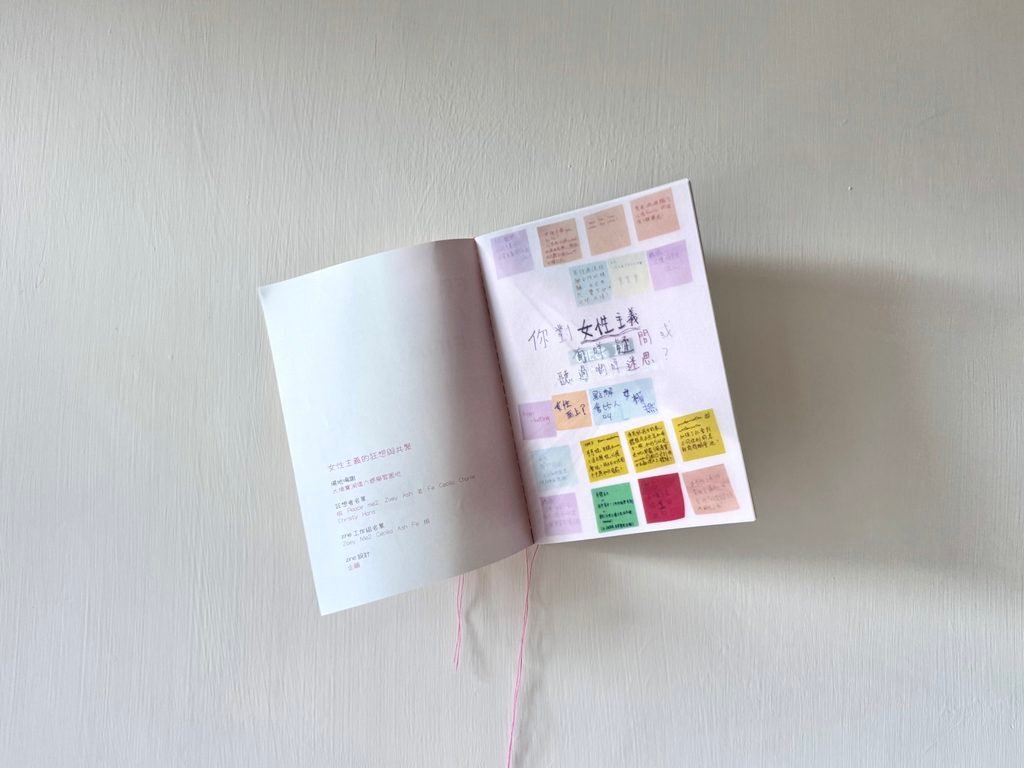
FDW_V1_Final: Feminist Dream Walking 25.07.01
This zine documents the wider 2025 Feminist Dream Walking festival, including both the Feminism 101 workshop and the public conference.
None of us had previous experience in zine publishing. Making the zine involved learning by doing: reflecting on our experiences and deciding what stories we wanted to share. We eventually produced 100 printed copies. Each copy was bound with a hanging string, a small gesture that symbolised our hope of creating new connections with people, ideas, and communities.
Why This Project?
For me, Feminist Dream Walking is not only a festival. It is an experiment in creative practice and public knowledge making. Through workshops, conversations, and self-publishing, I work with others to explore how feminist ideas can move beyond the university . It is a project grounded in our friendship, voluntary labour, and the belief that knowledge grows with people.
(Re)examining LGBT Media Representations & Societal Impact
I am a team member on (Re)examining LGBT Media Representation and Societal Impact: Perspectives from Hong Kong LGBT Community and the Public, an interdisciplinary project funded by the Interdisciplinary Research Seed Funding (2024–25), Faculty of Social Science, CUHK.
Working with team leader, Dr. Mengzhe Feng (School of Journalism and Communication, CUHK) and Lazar Dragić (School of Journalism and Communication, CUHK), we explore how LGBT people in Hong Kong experience media representations of their communities and how these representations shape public attitudes.
Drawing on my background in cultural studies, feminist theory, queer theory, platform studies, and activist research, I was invited to join the team. I worked with Feng in conducting interviews with LGBT community members in Hong Kong and contributed to qualitative coding, thematic analysis, and translation. Together, we collected and analysed narratives from dozens of participants to better understand the social impact of LGBT representation across different media forms.
The project was presented internationally by our team leader at the Distributed Citizenship Workshop at the University of Bergen, Norway, connecting our research to broader discussions on media, citizenship, and the public.
We are currently preparing publications based on our findings.
Digital Feminisms in Asia Symposium
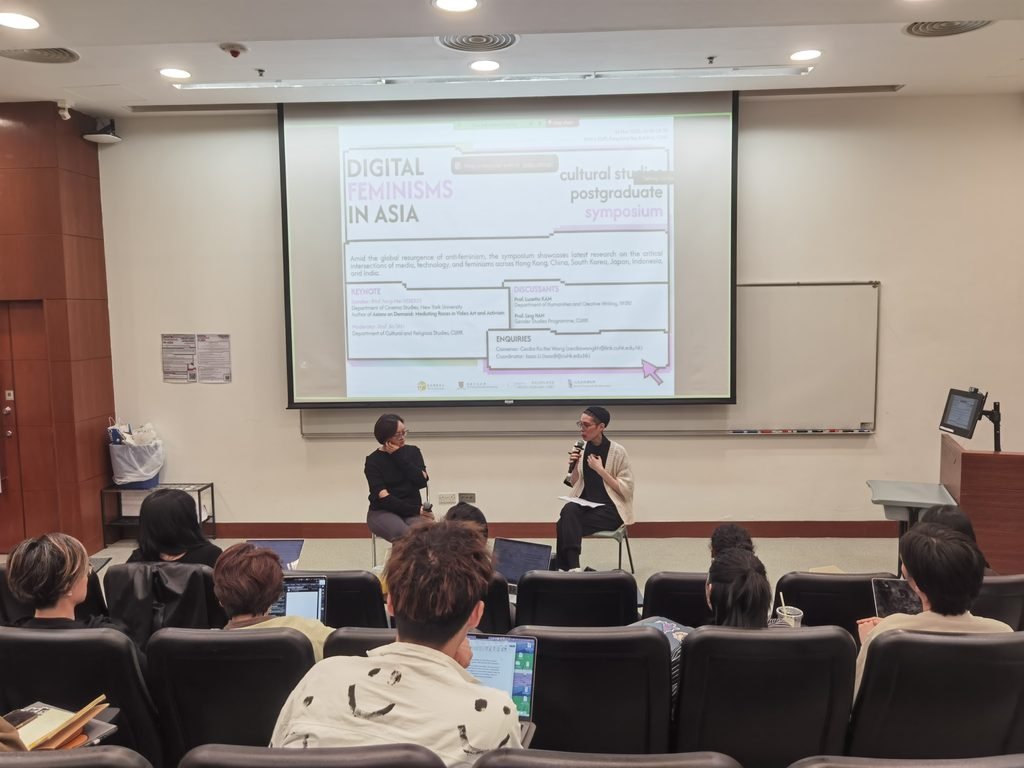
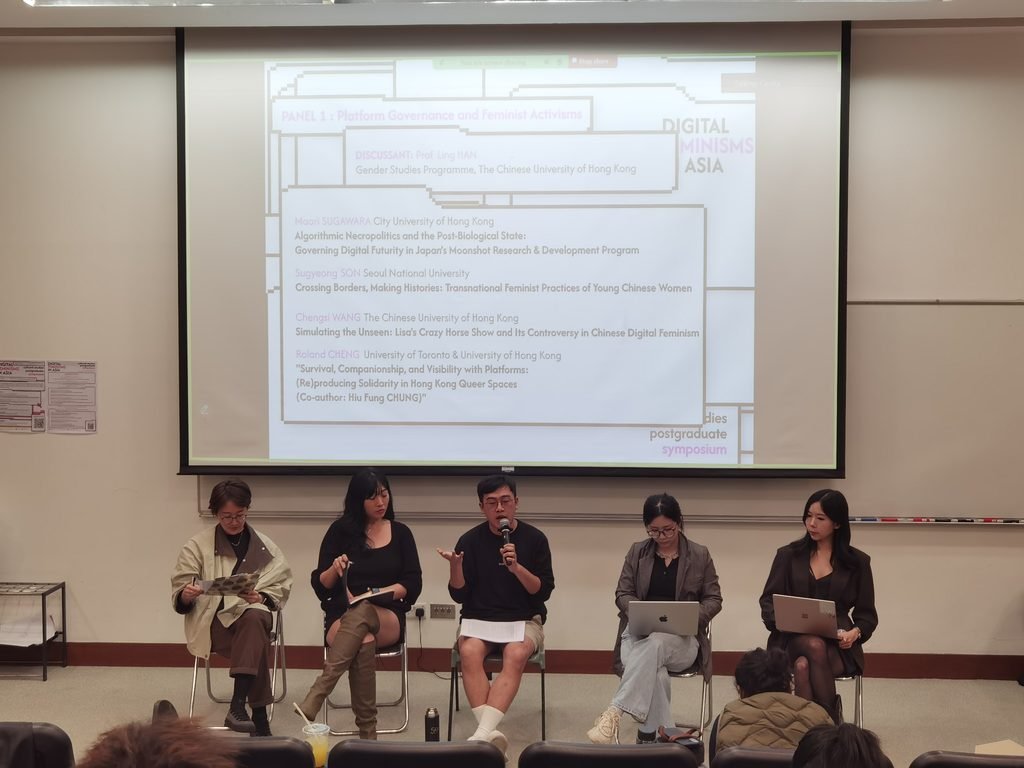
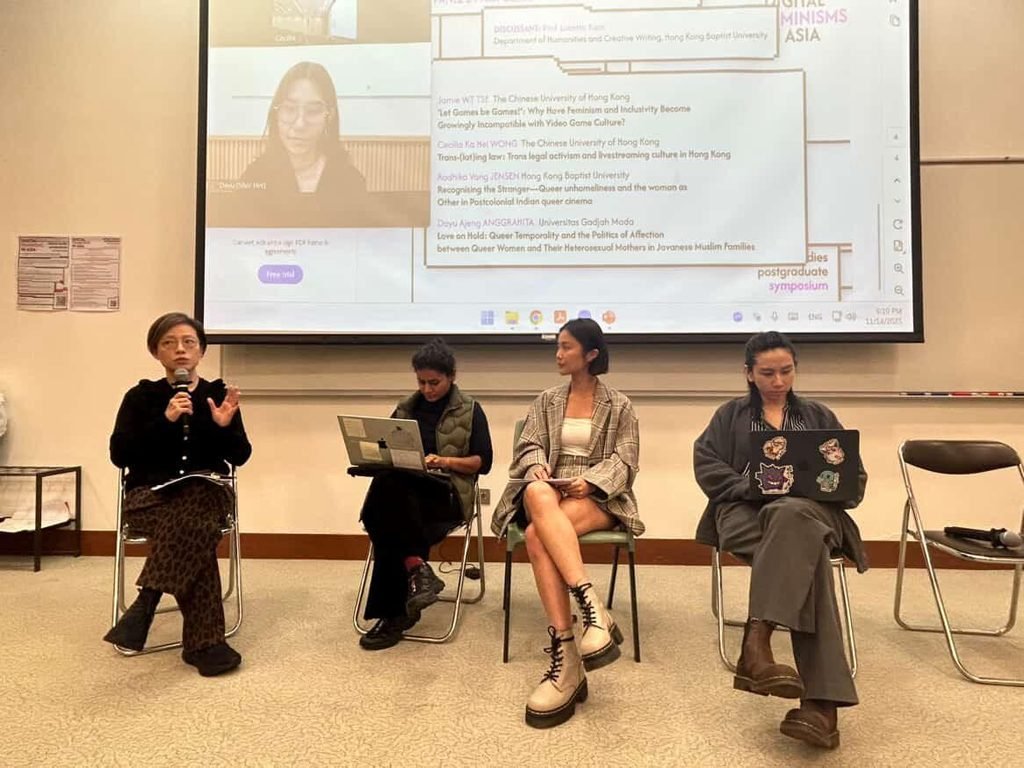
In Nov 2025, I convened the Digital Feminisms in Asia: Cultural Studies Postgraduate Symposium, a conference and creative workshop organised under the Digital Feminisms in Asia interdisciplinary research project.
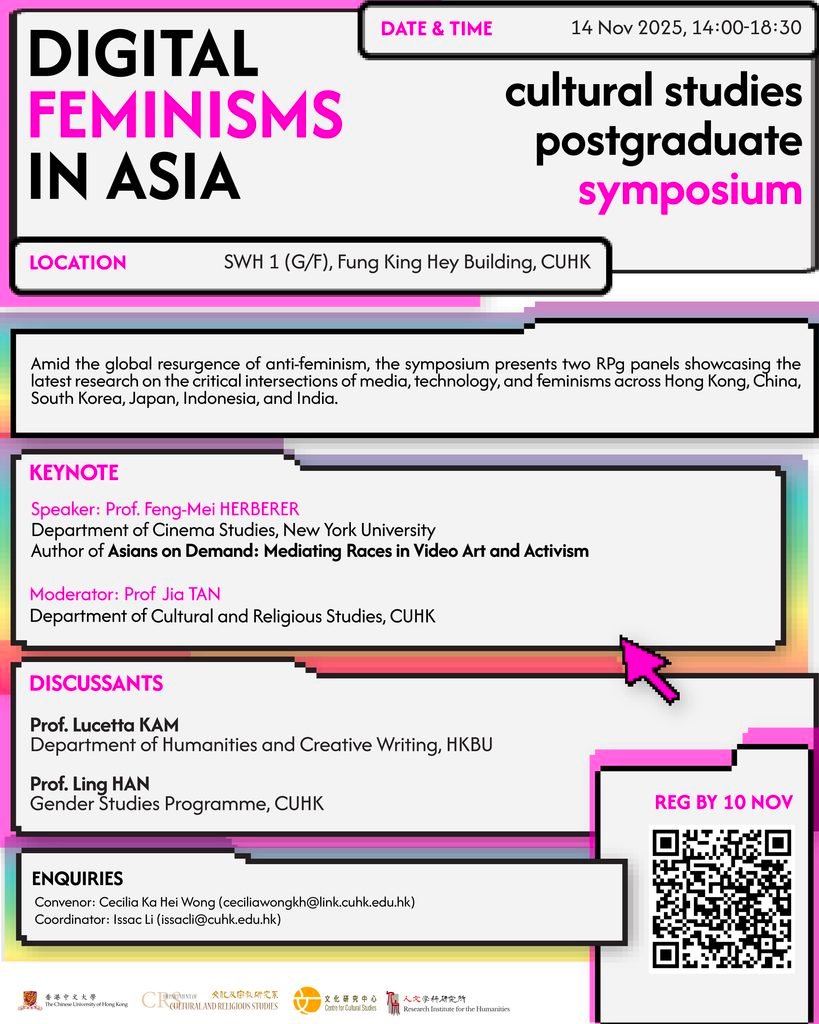
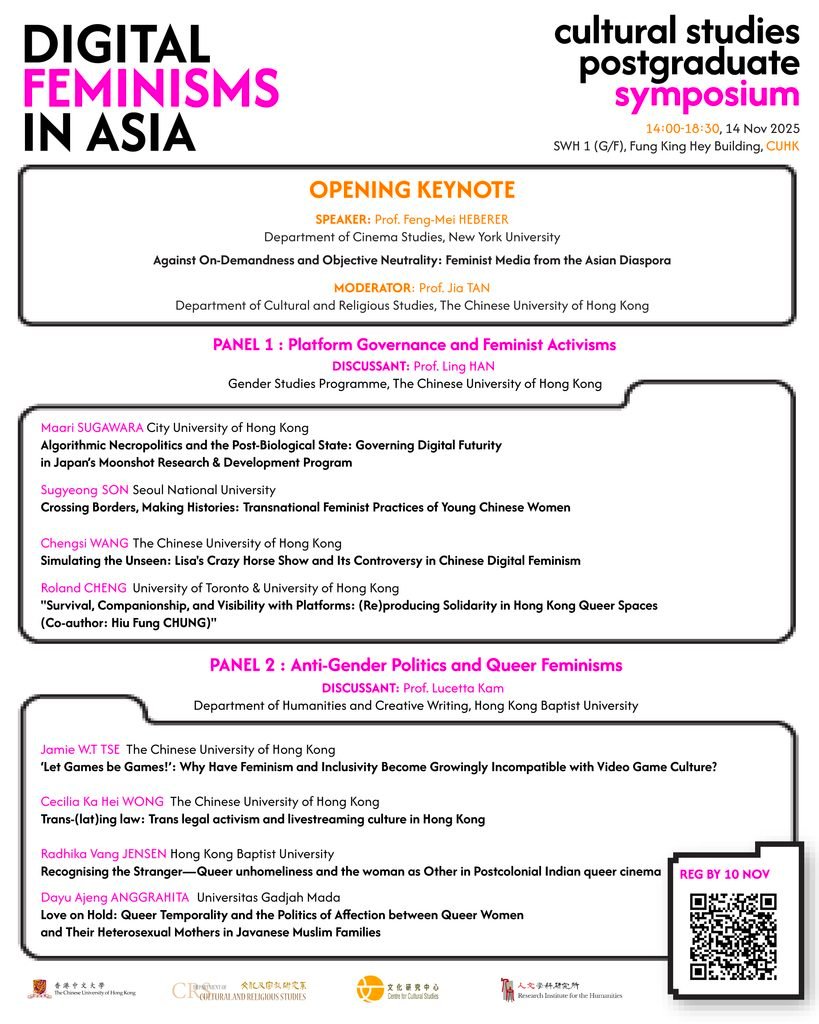
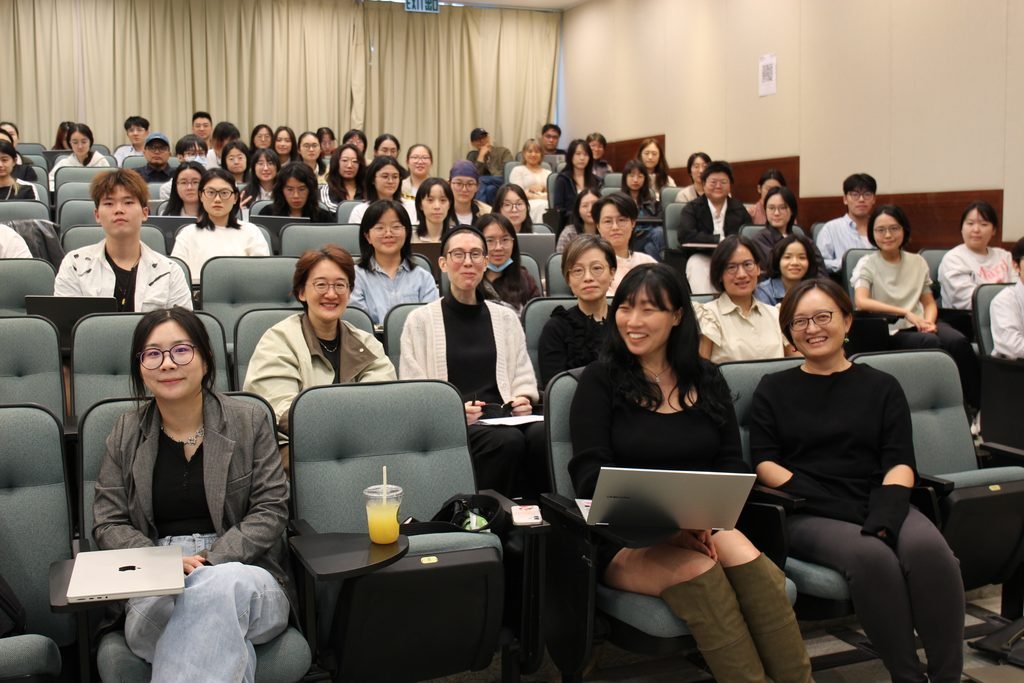
The poster is designed by Tian Yang.The poster is designed by Tian Yang.We had a big crowd over 100 participants.
The symposium brought together emerging researchers, artists, and activists to explore how media and digital technologies shape feminist politics across different Asian contexts. At a time when anti-feminist and anti-gender movements are gaining visibility around the world, I wanted to create a space for critical dialogue on digital feminisms in Asia.
I invited Prof. Feng-Mei Heberer (New York University), author of Asians on Demand: Mediating Race in Video Art and Activism, to deliver the keynote lecture, ‘Against On-Demandness and Objective Neutrality: Feminist Media from the Asian Diaspora’. I also brought together early-career researchers working at the intersections of media, technology, and feminisms across Hong Kong, China, South Korea, Japan, Indonesia, and India. Their work was discussed by Prof. Lucetta Kam (Hong Kong Baptist University) and Prof. Ling Han (The Chinese University of Hong Kong).
The symposium welcomed more than 100 members of the public, creating opportunities for exchange across disciplines, institutions, and contexts.
Pre-Symposium Creative Workshop
Before the symposium, I invited Charis Poon, feminist zine maker, designer, and Teaching Fellow at The Hong Kong Polytechnic University, to facilitate a creative workshop for presenters.
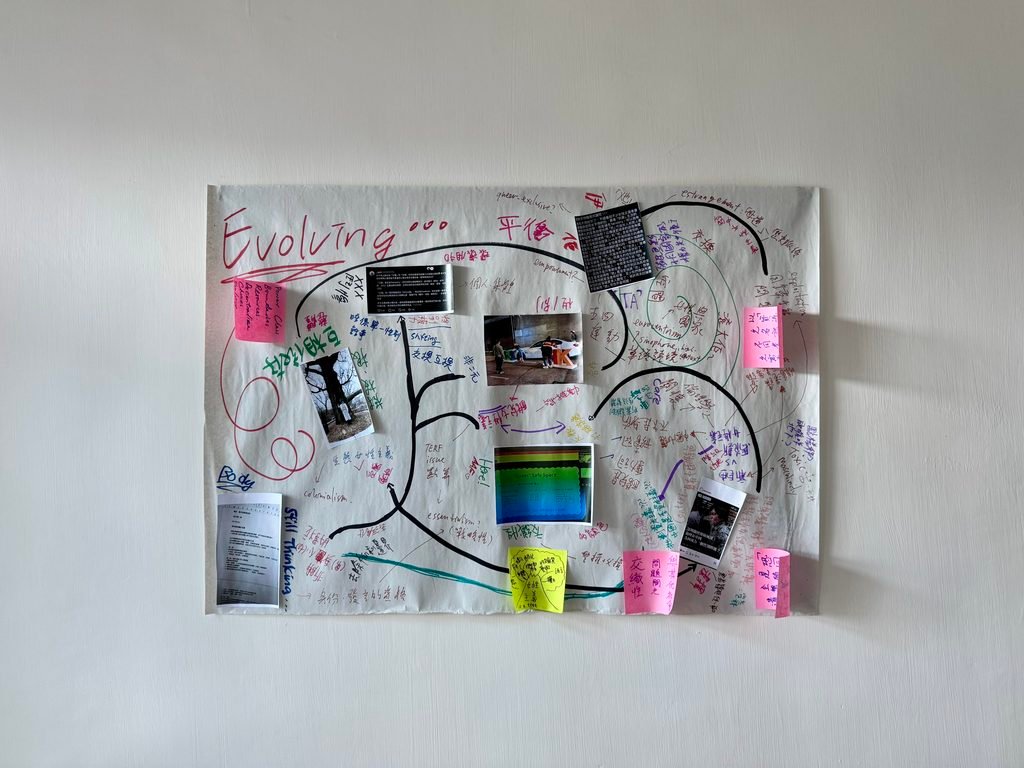
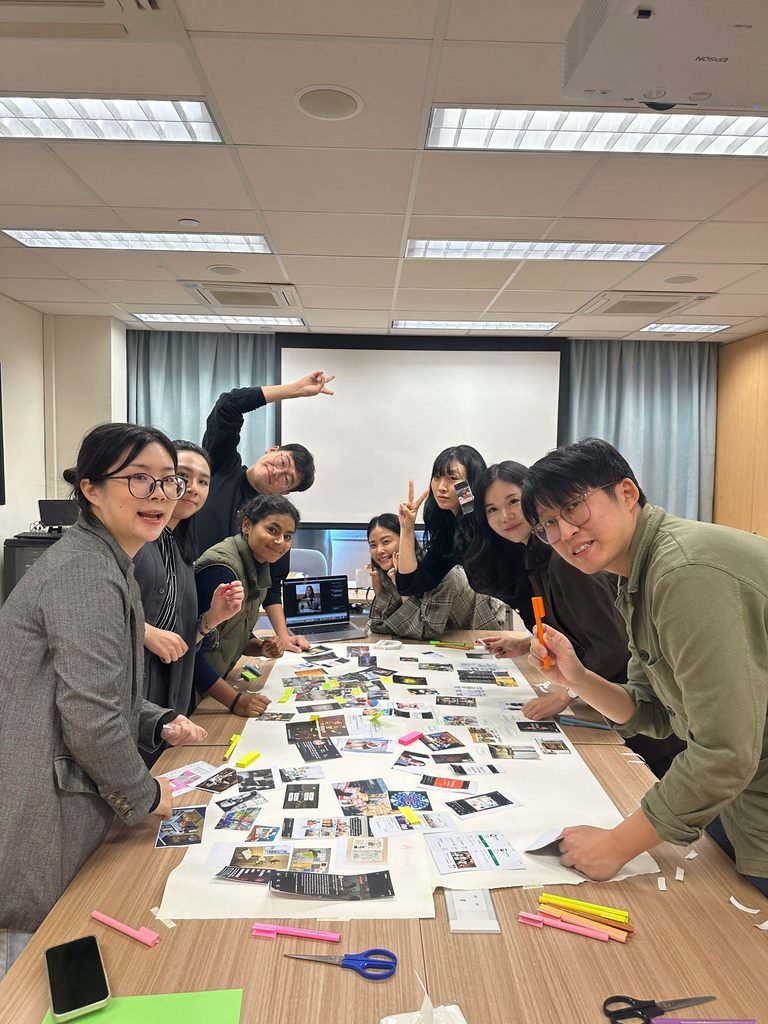
Rather than simply sharing research findings, participants worked together to reflect on what it means to research digital feminisms across six Asian contexts. Through discussion, drawing, mapping, and zine-making, we translated academic ideas into creative forms and produced two collaborative creative outputs.
We visualised the connections bewteen our research through mapping.
This is the digital zine we made together.
Post-Symposium Walking Tour
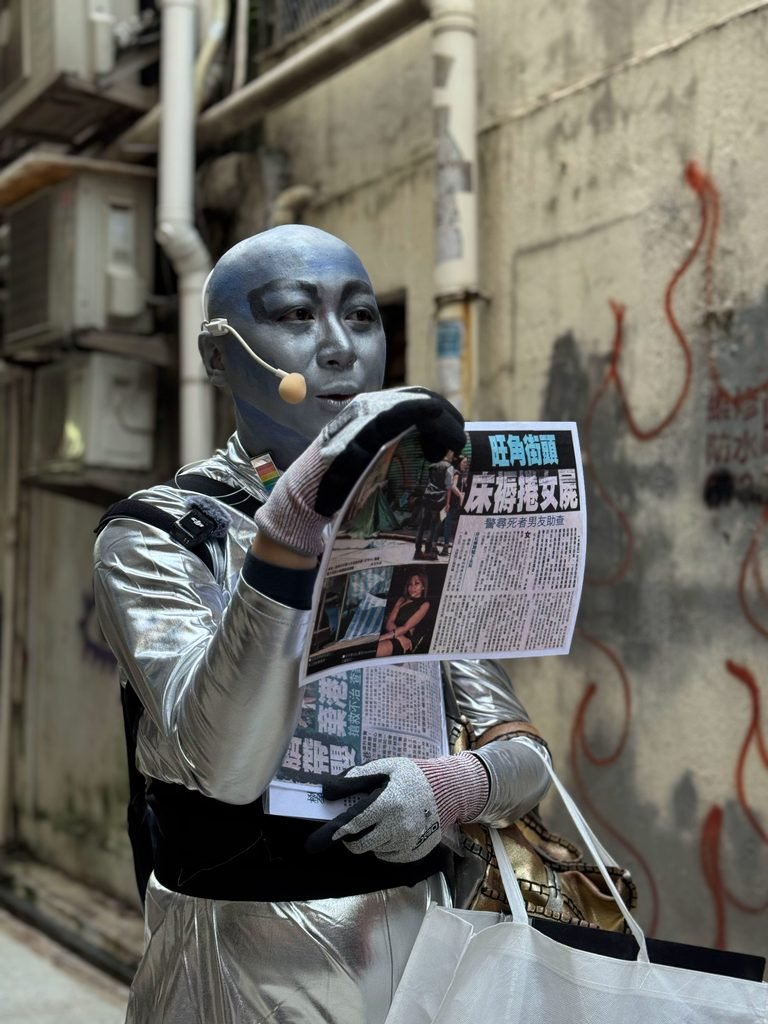
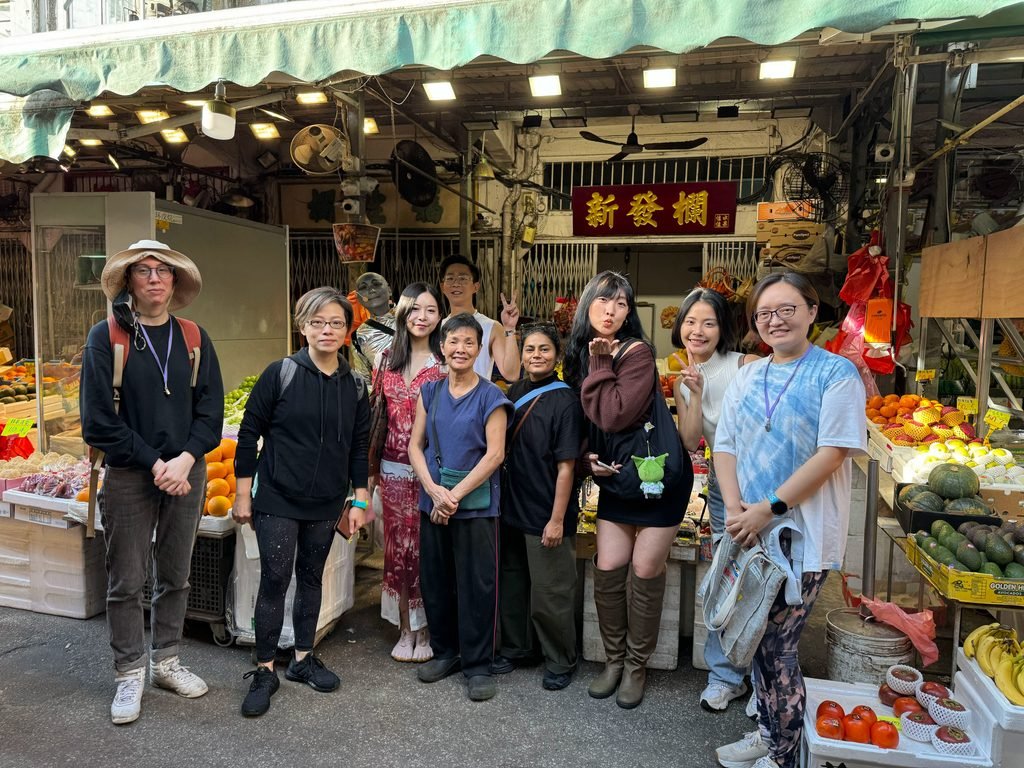
Research does not only happen in conference rooms. After the symposium, I invited queer feminist artist and activist Holok Chen to lead a walking tour of the Yau Tsim Mong district.
The tour explored the intersections of gender, race, migration, and urban development in everyday city spaces. By moving beyond the university campus, participants were able to connect discussions of digital feminisms with the social and material realities of Hong Kong.
Why This Project?
This symposium was more than an academic event. It was an experiment in bringing together research, creative practice, and public engagement. By connecting scholars, artists, activists, and students across Asia, I sought to create a space for collective learning and to imagine new feminist approaches to media and technology in a rapidly changing digital world.
Staying with Digital Troubles
Staying with Digital Troubles is a public humanities project supported by the 2026/27 Public Humanities Outreach Fund at the Centre for Cultural Studies, The Chinese University of Hong Kong.
The project explores how digital technologies shape everyday life, especially in moments of uncertainty and rapid change, and what new forms of critique and imagination are possible under these conditions. Hong Kong, where people move across American and Chinese digital platforms and media systems, while also experiencing the limits and exclusions that come with these infrastructures, occupies a unique position between global technology powers that deserve a close look.
As Principal Investigator, I work closes with the co-investigators Ka Ying Wong and Prof. Jia Tan from the Department of Cultural and Religious Studies at CUHK, and bring together researchers, artists, designers, and cultural practitioners from different disciplines and institutions to build new conversations around technology, gender, and change. Through creative practice and public engagement, the project translates critical digital, AI, STS and humanities research into accessible forms of public knowledge.
The project consists of two main events:
Digital Troubles Research Zine Workshop
This workshop invites researchers working on digital media, AI, platforms, games, queer studies, feminist studies, and related fields to turn their research into zines. Facilitated by designer, educator and zine-maker Charis Poon (PolyU), the workshop explores how research can reach wider publics through creative practice.
Staying with Digital Troubles Exhibition
The exhibition is a two-day public event held at Eaton HK on 9-10 January 2027.
The exhibition will showcase zines produced through the workshop alongside a series of public programmes exploring AI, digital culture, and queer feminist perspectives on technology. Planned activities include a film screening on AI, hosted by Emilie Sin Yi Choi (School of Creative Media, City University of Hong Kong), with Prof. Jia Tan (CUHK) as discussant, and an artist-led workshop on deepfakes facilitated by Maari Sugawara (School of Creative Media, City University of Hong Kong).
More programme details will be announced closer to the event.
Why This Project?
This project bridges academic research, creative practice, and public engagement. It creates opportunities for people to think critically about digital technologies while exploring alternative ways of understanding and responding to technological change. By bringing humanities research into public spaces, it offers tools for reflection, dialogue, and collective imagination at a time when digital developments increasingly shape everyday life.
Annotating AI-Generated Stories
In April 2026, I was invited as a Visiting Guest Researcher at the Centre for Digital Narrative, University of Bergen, Norway, through the AI STORIES project, funded by the ERC Advanced Grant AI STORIES (G.A. ID: 101142306).
As part of the project, I analysed 150 GPT-4-generated stories set in Hong Kong, Taiwan, and China. Using qualitative coding, thematic analysis, and contextual comparison, I examined how AI constructs narratives across different East Asian contexts. The analysis focused on narrative arcs, forms of conflict, character gender, and professional roles.
This work contributed to a human-annotated dataset that offers insight into the patterns, assumptions, and cultural representations found in AI-generated storytelling. Alongside this research, I delivered a lecture on queer feminist approaches to synthetic arts and AI-generated culture.
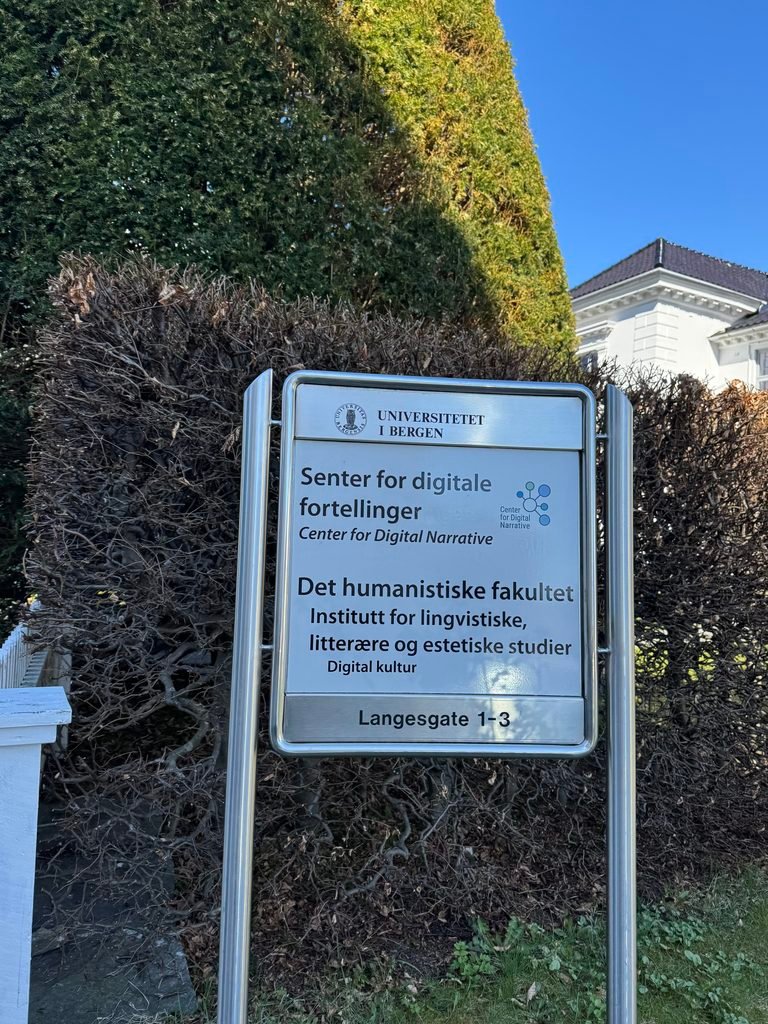
I took this photo of the Center for Digital Narrative’s sign the first day there.
We recently published the annotation dataset here:
Hagen, E. M. S., Rizvi, Z., Rettberg, J. W., Wong, K. H., John, J. C., Bodor, N. N., Efimova, V., & Witte, J. (2026). Metadata about AI-generated stories: Expert, human annotation relating to conflict, character gender and profession (Version 1.0) [Dataset]. DataverseNO. https://doi.org/10.18710/KQSFOT

Leave a Reply